Where Did the Money Go? The Silent Profit Killer Hiding in Your Bar's Pour Spouts
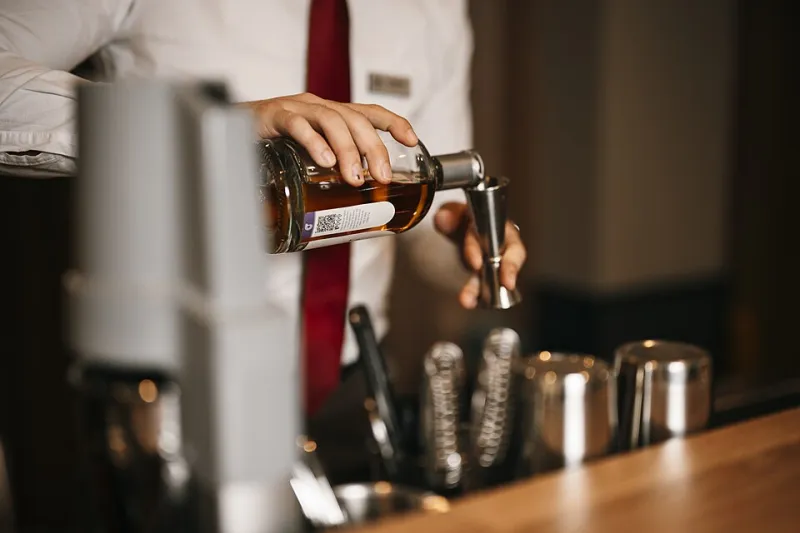
Photo: Shixart1985, CC BY 2.0, via Wikimedia Commons
You counted your bottles at the start of the week. You counted them again at the end. And somehow, the math still doesn't add up. Welcome to what operators are calling the ghost inventory problem—a frustrating, expensive, and surprisingly common issue that bleeds money out of bars regardless of size, concept, or price point.
It's not always theft. It's not always negligence. Sometimes it's just a heavy-handed pour on a busy Saturday, a comp that never got logged, or a free taste that became three. Multiply those moments across a week, a month, a quarter—and you're looking at a very real hole in your bottom line.
The Scale of the Problem
Industry estimates suggest that the average US bar loses between 20% and 25% of its potential beverage revenue to what's broadly called "shrinkage"—a catch-all term covering over-pouring, spillage, untracked comps, and outright theft. For a bar doing $1 million in annual beverage sales, that's up to $250,000 walking out the door in ways that never hit the POS system.
Pour cost—the ratio of what you spend on product versus what you sell—is the metric most operators use to gauge efficiency. The industry benchmark sits around 18% to 24% for spirits-heavy programs. Drift above that number without understanding why, and you're essentially running a charity for your regulars.
But here's the thing: most bars don't even know their actual pour cost in real time. They find out weeks later, after invoices are reconciled and inventory sheets are tallied. By then, the damage is done.
Three Bars, Three Different Problems
The Dive Bar: Volume Without Visibility
Take a classic neighborhood dive—let's call it the kind of place with $4 domestics, a jukebox, and a bartender who's been there since the Clinton administration. High volume, low margins, loyal crowd. Sounds stable, right?
The problem in these environments is speed over precision. When you're slinging drinks three deep on a Friday, nobody's counting ounces. A standard 1.5 oz pour becomes 1.75 oz, then 2 oz when the bartender likes you. Over a 200-cover night, that extra quarter-ounce per drink adds up to dozens of free drinks' worth of product.
Dive bars also tend to rely on manual, paper-based inventory systems—or worse, gut instinct. Without a baseline, there's no way to identify where the losses are concentrated. Is it the well spirits? The draft lines? The back bar? Nobody knows, and that ambiguity is expensive.
The Craft Cocktail Bar: Complexity as a Liability
On the opposite end of the spectrum, craft cocktail programs face a different version of the same issue. Menus featuring house-made syrups, infusions, clarified juices, and multi-component builds introduce a ton of variables that are genuinely hard to track.
When a cocktail calls for 0.75 oz of a house-infused bourbon that took three days to make, how do you cost that accurately? Most craft programs don't. They approximate. And approximations compound into real money when a menu has 20 original cocktails, each with four to eight components.
Batch prep is another culprit. Pre-batched cocktails are operationally smart, but if the person batching isn't measuring precisely—or if the recipe hasn't been properly scaled—you can end up over-producing and writing off product that never generated revenue.
The High-Volume Nightclub or Sports Bar: The Accountability Gap
At high-volume venues—think multi-room nightclubs, stadium-adjacent sports bars, or rooftop operations running multiple bar stations simultaneously—the ghost inventory problem becomes a management challenge as much as a bartending one.
With eight bartenders working across three stations, who's accountable for the back bar? How do you track which station is over-pouring? When a manager comps a round for a VIP, does that get logged immediately or reconstructed at close? In these environments, accountability gaps are structural, not individual.
High-volume bars also tend to have the highest exposure to theft—not because their staff is less honest, but because the pace and scale of operations make it easier for discrepancies to go unnoticed.
The Tech Layer That Changes the Game
The good news is that the tools to address ghost inventory have gotten dramatically more accessible over the last five years. A handful of platforms—Bevager, BevSpot (now part of Craftable), and Partender among them—have brought real-time inventory management within reach of independent operators, not just large chains.
These platforms work by connecting purchasing data, recipe costs, and sales data from your POS into a unified view of theoretical versus actual usage. The gap between those two numbers is your shrinkage. Seeing it clearly, in real time, is the first step to doing something about it.
Some operators are also adopting smart pour spouts—devices like Pisco or Berg that track every pour electronically and sync with inventory systems. They're not cheap, and some bartenders push back on the surveillance feel, but for high-volume venues where a single station can move hundreds of bottles a month, the ROI case is hard to argue with.
What You Can Do Right Now
Tech is great, but you don't need a $500/month platform subscription to start recovering margin. Here are a few practices that any bar can implement immediately:
Standardize your pours and test them regularly. Use a jigger. Always. Train your staff on why it matters—not as a punishment, but as a professionalism standard. Then do blind pour tests monthly. You'll be surprised how quickly habits drift.
Count more frequently. Weekly counts beat monthly counts. Daily counts on high-velocity items—well spirits, draft handles, house wines—beat weekly. The closer your count interval is to real time, the faster you can identify and address anomalies.
Build a comp and spill log. Every freebie should be logged. Every spill, every breakage, every taste. Not to punish bartenders for being human, but to separate intentional hospitality from untracked loss. You can't manage what you can't see.
Cost every recipe—for real. Not an estimate. Pull your actual invoice prices, measure your actual yields, and build recipe costs that reflect reality. Update them when supplier prices change. It's tedious, but it's the foundation everything else sits on.
Set a target and track toward it. Pick a pour cost goal that's appropriate for your concept and price point. Review it weekly. Celebrate when you hit it. Investigate when you don't.
The Bigger Picture
Ghost inventory isn't a new problem. Bars have been losing money to untracked pours since the first saloon opened its doors. What's changed is that operators now have the tools, the data, and frankly the margin pressure to actually do something about it.
The bars that are winning right now—the ones posting healthy margins in a tough cost environment—aren't necessarily the ones with the most creative menus or the best locations. They're the ones that treat their back bar like a business, not a vibe. They know their numbers. They hold their teams accountable in ways that feel fair and transparent. And they've stopped pretending that a little over-pouring is just the cost of doing business.
Because it's not a little. It's thousands of dollars. And it's yours to keep.